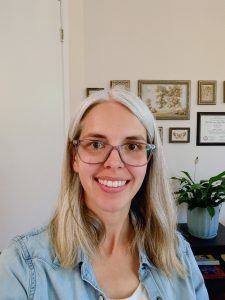
Gail Kirk Poust, LMFT
Reproductive Mental Health Therapist
License state: California
License: CA LMFT #128899
License verification link: Board of Behavioral Sciences
Practicing since: 2014
Education
- Master in Science in Marriage, Family and Child Counseling from San Francisco State University.
- Bachelor of Arts in Anthropology and Sociology from the University of Illinois.
Trainings
- Training in Reproductive Mental Health:
- Maternal Mental Health Professional Certificate Training, 2022, 16 hours
- Reproductive Grief Specialization Certificate, 2026, 12.5 hours
- Women with Trauma and Serious Mental Health Disorders, 2026, 6.5 hours
- Treat Pre-Menstrual Dysphoric Disorder, Premenstrual Syndrome & Emotional-Dysregulation with DBT & CBT, 2026, 4.5 hours
- An Integrative Approach to Menopause, 2026, 1.5 hours
- Training in Chronic Pain and Illness:
- Acceptance and Committment Therapy (ACT) for Chronic Pain, 2026, 12.5 hours
- Additional Training:
- 2-Day Intensive Trauma Treatment Certification Workshop, 2022, 12 hours
- New Techniques of Grief Therapy: Bereavement and Beyond, 2025, 17 hours
Memberships
- CAMFT – California Association of Marriage and Family Therapists
- EBCAMFT – (San Francisco) East Bay Chapter of CAMFT
- PSI – Postpartum Support International
Professional Bio
I am a reproductive mental health therapist because I have lived on both sides of this work.
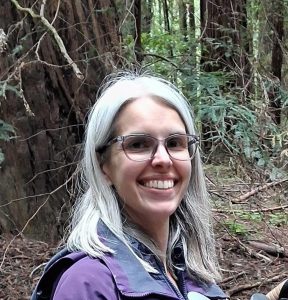
Time outdoors is my favorite self-care.
If you have found your way to this page, you may be carrying something that the people around you can’t quite see. The pregnancy that ended, and the way the world moved on before you did. Infertility’s monthly cycle of hope and grief. The person you used to be before baby came, whom you barely recognize. The body that changed the rules on you, whether through PMDD, perimenopause, or chronic illness, while everyone around you insisted it was normal, or hormones, or in your head.
I know this territory personally. I have walked through miscarriage, infertility, pregnancy, perimenopause, and chronic health conditions myself. In my own healing after loss, I came up against the same question so many of my clients bring into the room: what would give my life meaning if I couldn’t have a child? Sitting with people through life’s hardest chapters became my answer. I went to graduate school for marriage and family therapy, and I never looked back.
My own experience is not a template for yours. No two stories are alike, and I will take the time to understand all the layers of yours. But it means that when you tell me you dread the two weeks before your period, or that baby showers feel unbearable, or that you love your child and grieve your old life at the same time, you will not have to convince me it’s real. You won’t be starting from the beginning. And I know the strategies I offer work, because I have used them myself and watched them work for my clients for over a decade.
My first encounter with therapy’s power came earlier, though. In college, buried in the anxiety of essays and exams, I discovered Cognitive Behavioral Therapy. I was stunned that concrete tools existed for the thoughts that were running my life. Why didn’t everyone know about this!?! That discovery set my direction. At the same time, my studies in anthropology and sociology taught me how much power lives in a person’s story, and how much of that story is shaped by culture, community, gender, and the expectations placed on us. That lens is why so much of reproductive struggle hurts the way it does: it isn’t just what is happening to you, it’s the story you’ve been handed about what it means. Helping you take back the authorship of that story is at the heart of how I work.
Whether you are trying to conceive, recovering from loss, adjusting to parenthood, riding the hormonal upheavals of PMDD or perimenopause, or learning to live in a body with a chronic condition — you don’t have to keep explaining yourself to people who don’t get it. I get it. Let’s find what works for you.
Treatment Approach

Every therapist has a toolbox. Here is mine, and more importantly, why it fits the work we’ll do together.
The foundation of my approach is Narrative Therapy. Reproductive life comes with heavy scripts: what a woman’s body is supposed to do, what a mother is supposed to feel, what grief is allowed to look like when there was never a funeral. When your body or your life doesn’t follow the script, it’s easy to conclude that you are the thing that’s broken. Narrative therapy pulls those stories into the light, asks where they came from, and helps you author a version of your life in which you are not the problem: one that aligns with your actual identity, values, and goals. My background in anthropology and sociology is why I start here. I was trained to see how culture writes itself into our most personal stories long before I was trained to help people rewrite them.
On that foundation, I layer research-backed tools chosen for your situation, not applied one-size-fits-all:
Cognitive Behavioral Therapy (CBT) for the thought spirals, like the 2 a.m. certainty that it’s your fault, that you’ll never feel like yourself again, that everyone is judging you. CBT gives you concrete ways to catch those thoughts and answer them.
Dialectical Behavior Therapy (DBT) for the moments that feel too big to think your way through, like the luteal-phase rage, the wave of grief in the grocery store baby aisle, the flare-day despair. DBT skills help you ride out intense emotion without it costing you your relationships or your self-respect.
Acceptance and Commitment Therapy (ACT) for the things that cannot be fixed, only carried such as chronic illness, or the family that looks different than you planned. ACT helps you stop spending your energy fighting reality and redirect it toward a life that still holds meaning.
Exposure and Response Prevention (ERP) for OCD and intrusive thoughts, including the postpartum intrusive thoughts that so many new parents suffer in silence. ERP is the gold-standard treatment for breaking the obsession-ritual loop.
Gottman Method and Gordon Effectiveness Training for the relationship strain that reproductive struggles create. Because infertility, loss, new parenthood, and hormonal upheaval are hard on partnerships, and good communication isn’t a skill until someone shows you how.
With this breadth to draw from, I can tailor our work to your needs and your life rather than forcing your story into a single method. And because my graduate training at San Francisco State University was grounded in multicultural counseling, the care you receive here is culturally sensitive, trauma-informed, and LGBTQIA+ affirming, whatever your story looks like, and whoever you are becoming in it.
“It always seems impossible until it is done.”
– Nelson Mandela